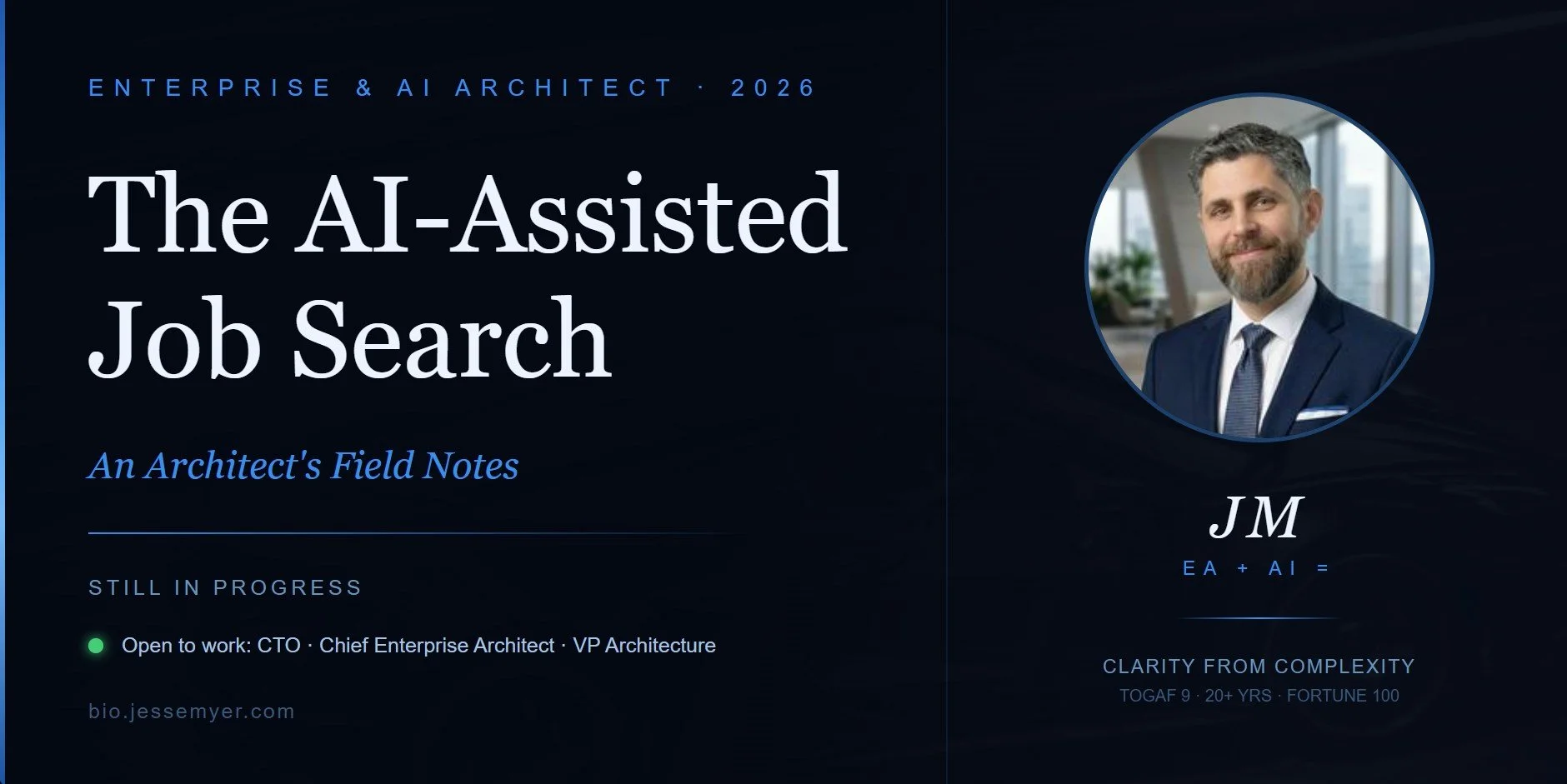
Enterprise Architect & AI Strategist. Views are my own.
There's an irony that doesn't escape me. I've spent 20 years helping Fortune 100 organizations navigate transformation at scale: $3.3B M&A integrations, cloud readiness assessments across 2,000+ applications, enterprise data science strategies that rewired how C-suites see their own businesses. And then I found myself needing to apply every one of those disciplines to the most personal transformation possible, finding my next role.
If you've read my Perspective posts, you know I believe in drawing from unexpected places. The archaeology piece. The urban planning parallels. The Hollywood MVP case study. The pattern holds: the problems we solve in enterprise are often the same problems humanity has been solving for centuries, just with different tools.
The job search is no different. And the stack I built to run it is worth documenting while the lessons are still fresh.
These are field notes. The search isn't done.
The Problem Nobody Talks About at This Level
At the CTO / Chief Enterprise Architect / VP Architecture level, the job search is an entirely different animal than what the career advice industrial complex was built for.
You're not spraying and praying on LinkedIn. You're operating in a narrow market where positioning does more work than keywords, where your narrative is the product, and where the person reading your materials has enough pattern recognition to spot a generic resume from a mile away. The AI-powered resume tools built for mid-level roles will flatten 20 years of Fortune 100 delivery into a bullet list and strip out everything that made you worth interviewing in the first place.
So I did what any architect would do. I designed a stack. And I ran it on real hardware.
The Hardware: Because the Stack Runs on Something
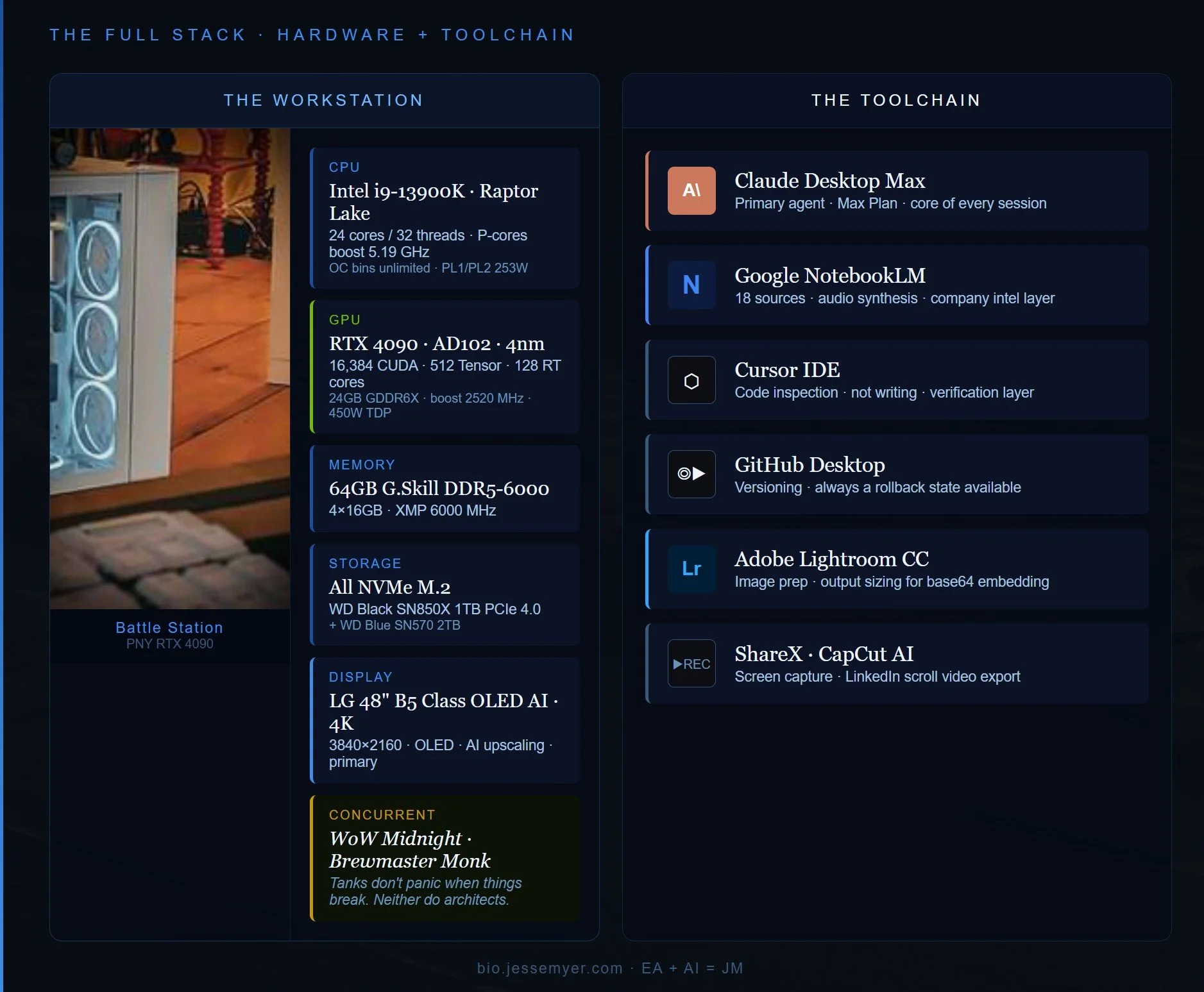
Before the software: the workstation matters when you're running this at the pace I was running it.
Windows 11 on an overclocked Intel i9-13900K (Raptor Lake, 24 cores, 32 threads, P-cores boosting to 5.19 GHz with OC bins unlimited), paired with a PNY RTX 4090 on the AD102 die: 16,384 CUDA cores, 512 Tensor cores, 128 RT cores, 24GB GDDR6X boosting to 2520 MHz. 64GB of G.Skill DDR5-6000 across four sticks. All storage on NVMe M.2, a WD Black SN850X 1TB on PCIe 4.0 as the primary drive. Primary display is an LG 48" Class B5 OLED AI 4K at 3840×2160.
When you're base64-encoding 77 images, running Claude Desktop on the Max Plan, Cursor, and Lightroom CC simultaneously, and iterating through 29 versions of a single HTML file across a weekend, thermal headroom and storage throughput are not abstractions. They're the difference between flow and friction.
The toolchain, specifically: Claude Desktop on the Max Plan was the primary agent throughout. Cursor handled code inspection, not writing, a critical distinction. GitHub Desktop managed versioning across iterations so there was always a known-good state to roll back to. Adobe Lightroom CC handled image prep and output sizing, specifically tuning photos for base64 embedding without bloating the file unnecessarily. ShareX/SnippingTool/Win+Shift+S handled screen capture. CapCut AI handled the scroll video posted to LinkedIn when the site launched.
And running concurrently in the background, across every long agent session: World of Warcraft Midnight, Brewmaster Monk. Tanks don't panic when something breaks. Neither do architects. There's a reason that's the class I play.
The Stack
Claude: Sparring Partner, Scribe, and Campaign Engine
I want to be direct here: I didn't use Claude to write my resume. I used it to think alongside me while I wrote my resume. The distinction matters.
When you've spent 20+ years inside Fortune 100 ecosystems, seven of them across insurance, healthcare, financial services, and industrial sectors, you accumulate so much signal that you lose track of what is signal. You stop seeing the M&A integration you led across 12 SAFe trains, 34 technology sectors, and 150+ architecture deliverables as remarkable, because to you, it was a Tuesday in 2018. Claude surfaces what you've stopped noticing.
I'd feed it a job description, my thinking on the role, and ask: where does my experience actually land here? Where am I rationalizing fit, and where is there genuine alignment? The back-and-forth sharpened both the resume and my judgment about which opportunities were worth pursuing at all.
For outreach, the workflow scaled into something more substantial. Claude built tiered target lists, 35+ companies ranked across Glassdoor happiness scores, skill match to my profile, and near-term profitability trajectory, then found named contacts at the CTO, CIO, and Chief Architect level for each. Not HR. Not recruiting coordinators. The right doors.
It also caught executive moves I would have missed entirely. Several C-suite and Chief Architect appointments had changed hands in the preceding 90 days across my target list. At the senior level, sending a message to the wrong person isn't just wasted effort; it signals you didn't do your homework, and that signal travels.
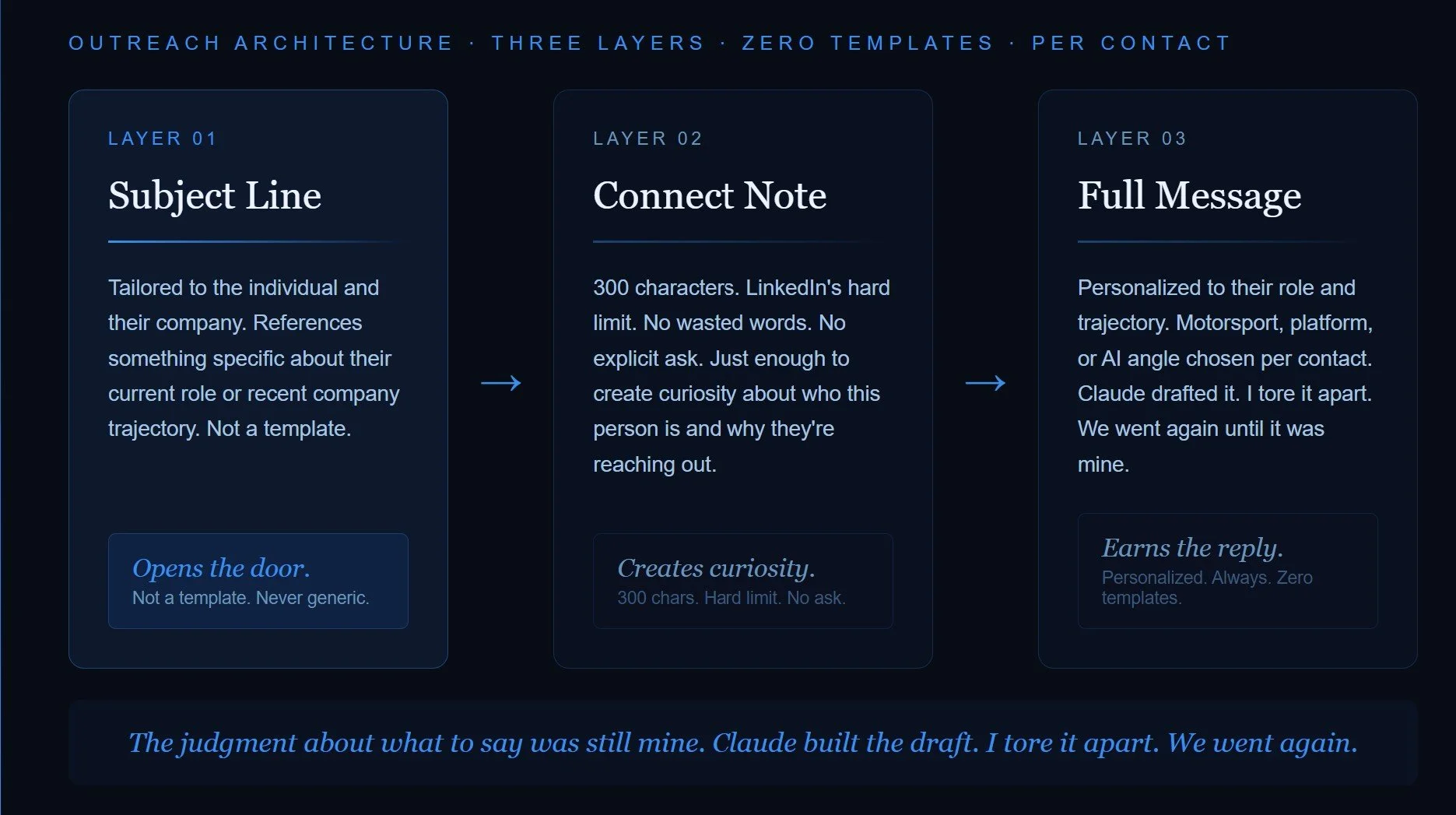
For each cold contact, Claude wrote three layers of copy:
The motorsport angle opened doors in the enthusiast space. The "20 years on the other side of your platform" angle opened insurance and financial services SaaS companies. The "built bio.jessemyer.com with Claude" angle opened AI-adjacent organizations.
Where it pushed back is equally worth noting. When Claude suggested a forward outreach ask that was too aggressive for a first cold touch at the CEO level, I redirected immediately: the message became three sentences, no explicit ask, just enough to create curiosity. That rewrite was the right call. It connected.
NotebookLM: The Intelligence Layer
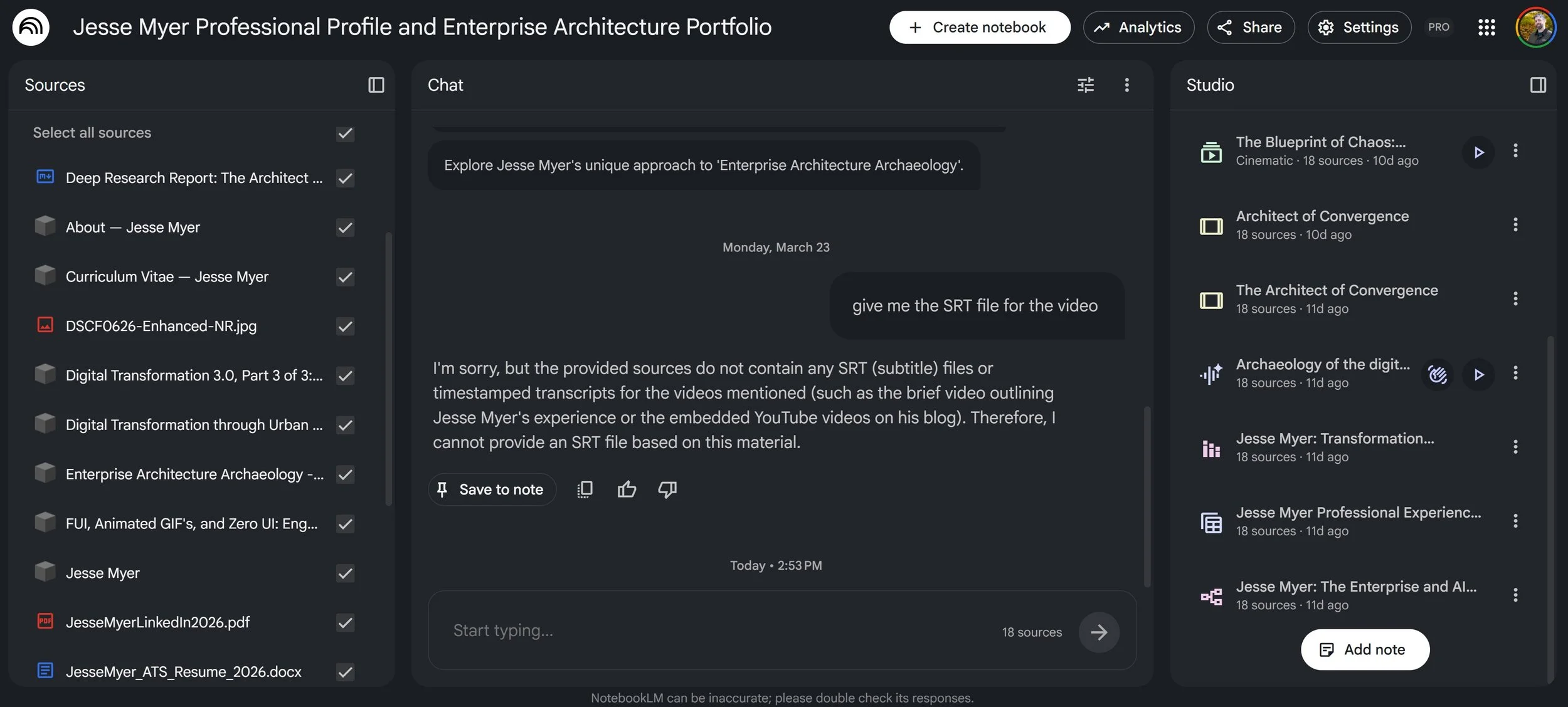
This one surprised me, and then became indispensable.
I built a NotebookLM workspace loaded with 18 sources: my Deep Research Report, CV, LinkedIn PDF, ATS resume, all my published Perspective articles, my About page, and supporting documents. The Studio panel generated named audio overviews from that material: "The Blueprint of Chaos," "Architect of Convergence," "Archaeology of the Digital..."; structured, listenable intelligence synthesized from my own source corpus, covering my career arc, architecture philosophy, and professional positioning from multiple angles.
That use case alone is worth understanding. Before any serious conversation with an organization, you need real intelligence: not the About page, not the LinkedIn overview. You need to understand their architecture maturity, where the genuine gaps are, what their job posting implies about where EA sits politically inside the organization. I loaded NotebookLM with company source material before every major conversation: annual reports, earnings calls, press releases, architecture-adjacent job postings, analyst coverage. It synthesizes across those sources into a coherent picture, and the audio overview delivers that briefing in a format that actually works while driving to the conversation.
The result: contextual depth that used to take a week to assemble, in a fraction of the time. The questions I ask are better for it, because synthesis surfaces what's inconsistent, not just what's stated.
bio.jessemyer.com: The Artifact
This one is different from the others because it's not a tool; it's an output. Built over a single weekend, across 29 versions, with zero lines of human-written code. One self-contained HTML file: 9.49MB, HTML5, CSS3, vanilla JS, D3 animated stat counters, Chart.js radar and stock performance charts, 77 base64-embedded images prepped in Lightroom CC, three downloadable resume formats, 11 LinkedIn recommendation quotes, a full career timeline with real company logos, six Signature Work programs, a $4.7B financial impact callout, and the Myer’s Miles motorsport section with nine real circuit track maps.
Claude wrote every line. Cursor inspected it. GitHub Desktop versioned it. Lightroom CC sized every image for optimal base64 weight before it went in. I wrote every requirement.
The architectural thinking transferred directly. Prompting a model to build something real is remarkably similar to writing a technical specification: altitude matters, order of operations matters, acceptance criteria matter, and knowing when to decompose a problem versus tackle it whole is the same instinct I've been using since I was doing QA at AOL in 2005 against 100 million global users.
The site is a living artifact. EA + AI = JM.
What AI Cannot Do
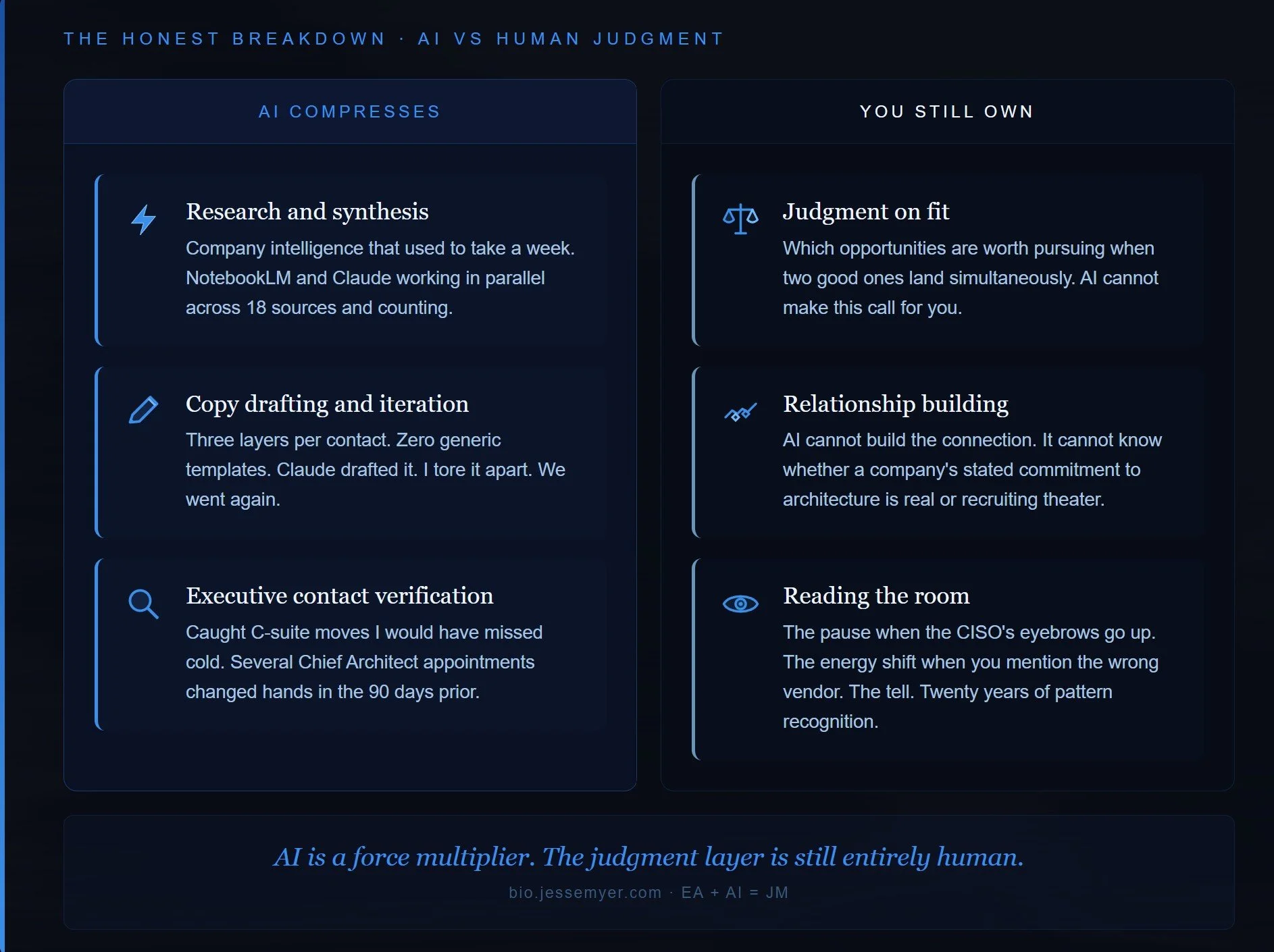
AI = Force Multiplier
It cannot tell you which opportunity is worth pursuing when two good ones land at the same time.
It cannot read the room in a conversation: the pause when the CISO's eyebrows go up, the energy shift when you mention the wrong vendor, the tell that the "Chief Architect" role is actually a staff position with a title.
It cannot build the relationship. It cannot know whether a company's stated commitment to architecture is organizational truth or recruiting theater.
Those judgment calls are still entirely human. What AI does, across every tool in this stack, is compress the time between "I need to think through this" and "I have something worth acting on." For a search that is by nature strategic, senior, and relationship-driven, that compression is real and material.
Worth noting: the pipeline produced results on day one. A target CEO connected within hours. A CCO at an AI-adjacent organization viewed my profile the same day. Warm contacts and first-degree evangelists began responding. Industry response rates on LinkedIn outreach run 5% to 35% and peak on Tuesdays and Wednesdays, three to seven days out. The architecture is built. Now it runs on its own schedule.
Field Notes Summary
What I can say with confidence: the architects, executives, and operators who use these tools as genuine thinking partners, who bring their own rigor and judgment to the collaboration, have a real edge over those who ignore them entirely and those who outsource to them entirely.
I've been building architectures for complex enterprises since AOL was a growth story. The discipline that makes a good EA, knowing what questions to ask, synthesizing across domains, sequencing dependencies, building toward a coherent target state, transfers cleanly to the problem of marketing yourself at the highest level of the profession.
The 20 years didn't become irrelevant when AI arrived. They became the backbone of using it well.
More to follow when there's more to report.
Jesse Myer is an Enterprise Architect and AI Strategist with 20+ years helping Fortune 100 organizations across insurance, healthcare, financial services, and industrial sectors translate complexity into achievable transformation. TOGAF 9 Certified Master Architect. Remote-native since 2013. Open to CTO, Chief Enterprise Architect, and VP Architecture roles.