
Identity Insurance 2125
What Will Next Gen. Identity Insurance Be?
Summary
In this article we will dive into identity insurance for the future, WHOA don’t close the window just yet! The sweet sauce is in the the two domains being met today, and the two domains with massive opportunity for tomorrow. And a quick disclaimer: This is all speculative thought and opinions, and definitely not a parenting article; as parenting challenges are innumerable across humanity.
Some topics we’ll be covering:
Ideation
Parental Challenges - Now and Then
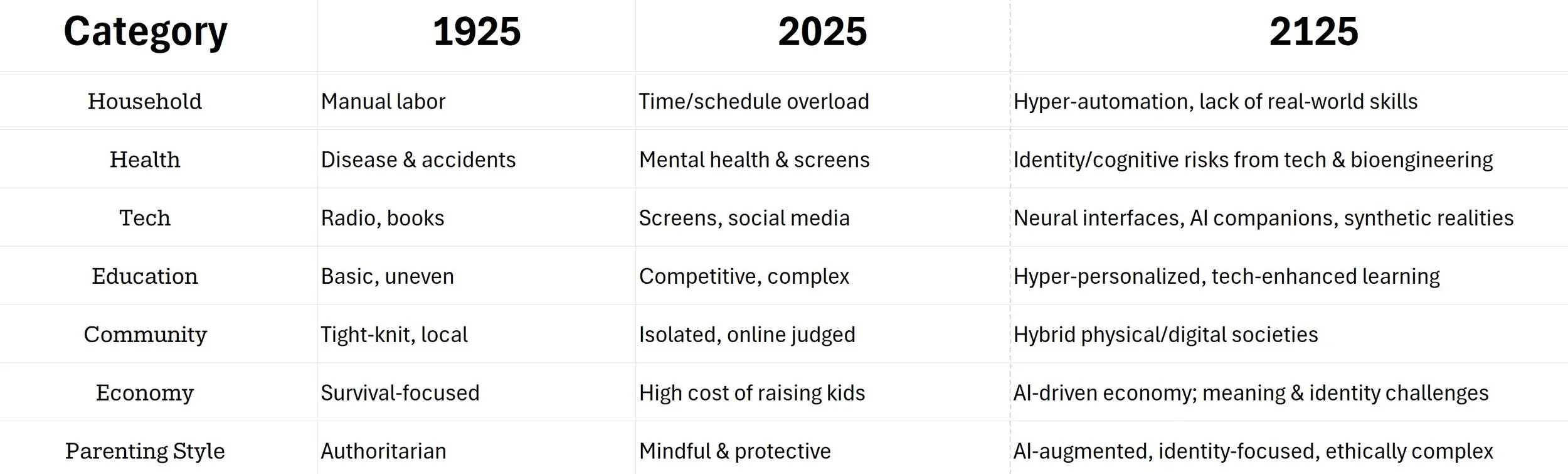
1925 vs 2025 vs 2125
The 2025 Parent: Overwhelmed by Multiple Selves
Identity Lifespan of a Child Born in 2025
Historical Evidence of Humanity Spanning Identity Crises
The 4 Domains of Identity Insurance
Market Outlook
Providers and Blue Ocean Market Segments
Risks and Gaps
Market Explosion 2025-2035
The New Insured Asset: The Self
A Speculative Strategic Business Plan (2028–2040): Own Identity Infrastructure
Tooling Used for this Article
“The future is already here, it’s just not evenly distributed.”
William Gibson, Neuromancer
Identity crises of 2125 are already visible in fragments today: deepfakes, avatars, AI personas, algorithmic self-shaping. We are living the early prototypes.
Ideation
In a group conversation, a friend posed the question about how hard raising a child in the year 2025 is. Some typical stuff came out of it:
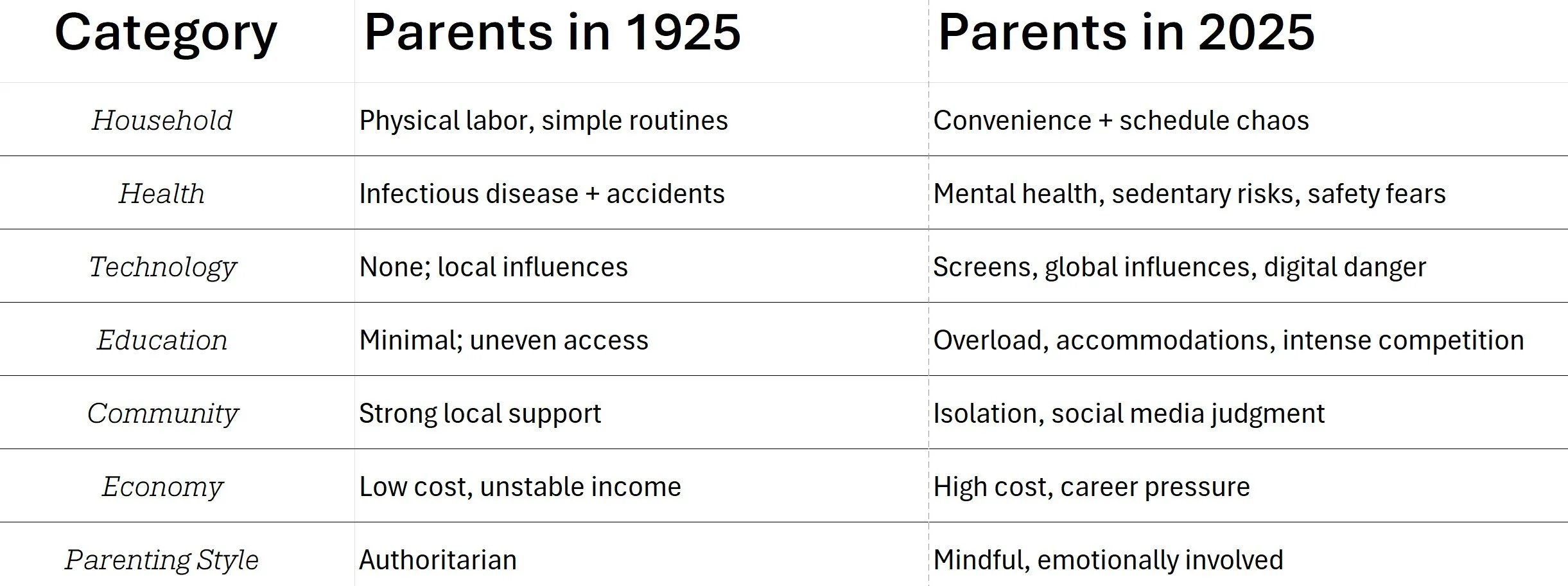
But is it harder now than before? And as expected we saw very familiar patterns emerge, it is expectedly very different now. Central themes and evidence suggested the primary differences were pretty self evident:
Parents in 1925 feared disease and accidents.
Parents in 2025 fear digital impersonation, deepfakes, algorithmic influence, and identity fragmentation.
– Pew Study on Modern Parental Anxiety
And although these are big topics, the #1 stressor for parents in 2025 remains economic; something to keep in mind for future opportunities of relief, more on that later. Although for some, it’s just having them eating their vegetables :)
We decided to blow out the question to "What are the different challenges for parents raising children in 1925 vs 2025 vs 2125” and a central theme emerged more prevalently, let’s see if you spot it (you should, it’s in the title)…
i·den·ti·ty
/īˈden(t)ədē/
noun
1. the fact of being who or what a person or thing is.
In 2125, identity-related issues may become one of the dominant challenges of childhood. This isn’t because people are weaker—it’s because the environment is radically more complex than anything humans evolved for. Humans evolved for a single physical world with slow developmental feedback.
Meanwhile, children of 2125 grow up in a multi-layered reality with instant modification, algorithmic shaping, and fluid selfhood. Identity doesn’t disappear—it becomes a lifelong design challenge instead of a natural developmental process.
Some of the wilder speculative challenges of 2125 include:
Children Live in Multiple Realities at Once
AI Companions Shape Identity From Infancy
Genetic Editing Creates “Identity Classes”
Reality Filtering and Memory Editing Distort Self-Continuity
Over-Optimization Undermines Sense of Self
Avatars Allow Endless Self-Reinvention (and Disconnection)
Hyper-Exposure to Microcultures Makes Identity Overwhelming
Privacy Is Gone—Identity Becomes Performed, Not Lived
The Meaning Crisis: What Is “Human” Anymore?

The greatest hazard of all: losing oneself.
Kierkegaard
Digital persona fragmentation, children shaped by invisible algorithmic forces, AI influence — Kierkegaard predicted the existential threat at the heart of 2125 identity. But we aren’t here to speculate wildly on 2125 children and parenting, this was just the ideation.
I’m an Enterprise Architect, dreaming is fun, but how do we make this a reality, what steps do we take? What is the roadmap to that speculative future? What are the challenges now and in the interim until 2125? What can make us feel protected or secure moving forward?
Aren’t there giant insurance companies and institutions doing this right now?
No, and that’s the surprise. Not one, but two speculative and novel markets, completely unsubstantiated and unfulfilled.
But first, let’s understand the business case, the reasons and the why’s, the speculative requirements…
The 2025 Parent: Overwhelmed by Multiple Selves
“Children maintain multiple digital selves while parents struggle to keep up. AI recommendations amplify identity shaping in ways parents can’t see or control.”
– APA Report on Technology & Identity
Children born in 2025 will face the beginning of the identity revolution, not the full storm of 2125. They will see the seeds planted, feel early versions of the fragmentation, help define the ethical boundaries and raise the first generation of partly enhanced children.
But the full identity crisis described for 2125 belongs to their late-21st-century children, and especially their early-22nd-century grandchildren. 2025 kids are the hinge generation— born at the end of the pre-augmentation era, living through the transition, and witnessing humanity’s identity transform.
Children born in 2025 (often called "Generation Beta") will face these challenges, but with a critical twist: they will be the "Immigrants" to this new world, not the natives.
While children born in 2125 will be born with neural links and edited genes, the child born in 2025 will have to choose to adopt them later in life. This creates a unique new set of "Bridge Generation" struggles. And oh my, children born in 2025 they have an interesting speculative roadmap ahead of them:
Ages 0–15 (2025–2040): The “AI-Coexistence Era”
Children born today will grow up with:
✔ Personalized AI everywhere
Tutor AIs
Emotional support AIs
Virtual play companions
Adaptive educational algorithms
This shapes identity by subtly influencing:
self-esteem
learning pace
behavioral norms
how they view relationships and authority
But it won’t fully replace parental influence.
✔ Algorithmic identity pressure
Like today’s teens, but deeper: Hyper-personalized feeds, early exposure to comparison culture, predictive profiling (“the algorithm thinks I’m this kind of person”) This creates early identity rigidity or confusion.

“No man ever steps in the same river twice.”
Heraclitus
Identity is increasingly fluid: online selves, avatars, curated feeds, AI-constructed realities. The river of the self is now algorithmically reloaded every refresh.
Ages 15–35 (2040–2060): The “Augmented Living Era”
By adulthood, they will experience the second-wave identity challenges:
✔ Augmented reality as a second world
Constant overlays, customizable environments, avatar-based interactions.
This creates tension between:
the physical self
the idealized AR self
the professional persona
the curated social presence
✔ AI-enhanced work and social expectations
Their professional identity will be intertwined with AI co-workers and personal AI amplifiers.
Some will ask:
“How much of my work is me, and how much is the AI?”
This proto-version evolves into full identity diffusion by 2125.
Ages 35–75 (2060–2100): The “Human Enhancement Era”
Children born in 2025 will be adults or elders during the rise of:
✔ Mainstream elective gene editing for future children
They’ll have to decide:
Should they edit their kids for intelligence?
Emotional stability?
Physical abilities?
Longevity?
Even if they don’t edit their children, they will live in a society stratified by enhancement—the earliest form of identity class division.
✔ Memory editing and emotional modulation emerging
Therapeutic memory softening and experience replay may become common by 2080–2100.
This challenges self-continuity—the seeds of a problem their grandchildren will fully inherit.
Lifespan Perspective: What 2025-born children actually endure
They will experience:
AI-shaped identity formation
intense comparison culture
augmented reality identity fluidity
algorithmic influence over personality
early enhancement inequality
first-generation neural interface pressures
blurred lines between online and offline selves
identity roles that change rapidly as tech iterates
They will not experience:
total immersion in multiple overlapping realities
widespread synthetic memory ecosystems
fully autonomous AI co-parenting
total privacy collapse
identity dissolution as the norm
society-wide engineered trait stratification
avatars indistinguishable from physical selfhood
Those are second- or third-generation effects. That’s pretty wild and definitely futurist, e.g. everything goes as planned. But I like history, examples and evidence.
So, has this happened before in history? Has there been example of humanity identity crises like this in the past? Yup, and let’s add in some speculation regarding post-AI eras, or concurrently.
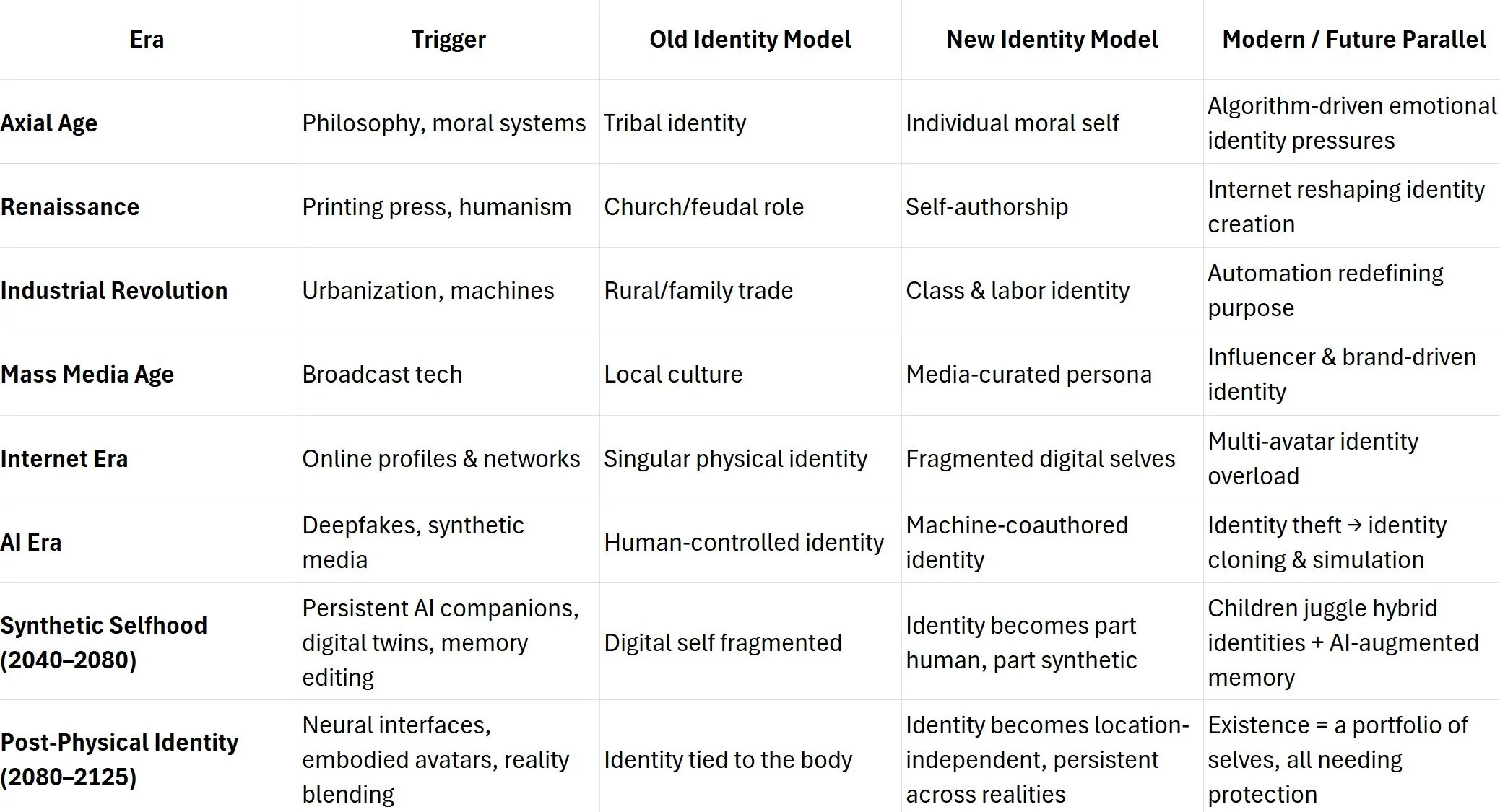
The 2025 identity crisis has three monetizable pain points:
1. People don’t know who they are.
2. People feel overwhelmed by digital personas & comparison.
3. Parents fear their kids’ identities being shaped by forces they don’t control.
Each produces high willingness to pay, especially among:
Upper-middle-class parents.
Aspiring professionals.
People with digital fatigue.
Creators and influencers.
Schools & institutions.
Corporations that need stable workforces.
High-anxiety consumers.
This makes identity a new gold rush. By 2030:
identity theft market = $20B
deepfake economy = $40B
cyber insurance = $200B
digital wellness = $15B
parental monitoring = $6B
reputation management = $5B
Identity Insurance overlaps ALL of these segments. By 2040, Identity Insurance could be a $300–$500+ billion global market. But how do we quantify and break down this big idea? Let’s look at Identity Insurance and the speculative domains.
The 4 Domains of Identity Insurance
1. Financial Identity
Covers credit files, SSNs, bank accounts, and financial fraud. Most identity-theft services protect only this domain. - FTC Identity Theft Data Book –
2. Legal Identity
Government-issued identity: passports, driver’s licenses, tax files, and official credentials. Threats include impersonation, forged documents, and corrupted records. - NIST Digital Identity Guidelines (SP 800-63)
3. Digital Persona Identity
Your online self: social profiles, avatars, voice, likeness, and digital reputation. Risks include deepfakes, AI impersonation, account cloning, synthetic media, and reputational destruction.
4. Existential / Psychological Identity
Your internal sense of self: self-esteem, coherence, emotional identity, and stability across real/digital contexts. Modern tech destabilizes this through comparison culture, algorithmic shaping, and multi-persona overload.
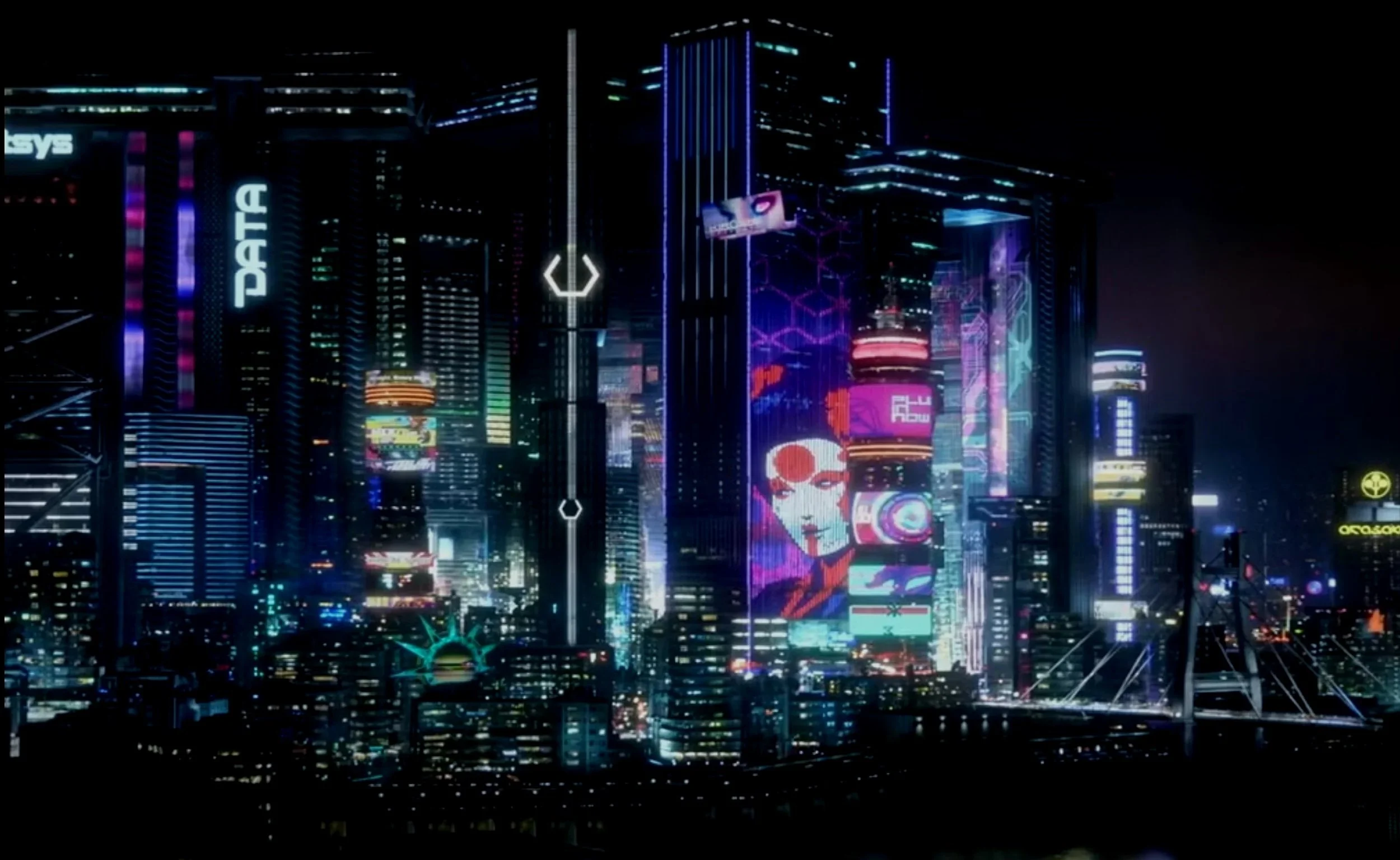
“In Night City, you can be whoever you want. At least that’s what they sell you.”
Cyberpunk 2077
Market Outlook
The illusion of infinite identity choice masks the reality: corporations and algorithms shape the choices. Identity freedom becomes identity marketing. There are already companies offering what’s broadly sold as “identity insurance” or “identity-theft / identity-fraud protection.” It’s not exactly the full-blown “identity-existential insurance” I described for 2125, but several businesses today provide services that cover part of the risk: identity theft, fraud, data breaches, and help with restoration, monitoring, or legal/administrative support.
Here are some examples:
LifeLock (part of Norton) — they offer identity-theft protection services including monitoring and recovery support. LifeLock
Allstate Identity Protection — provides identity monitoring, fraud alerts, identity restoration services, and insurance-type coverage for identity fraud losses. Allstate Identity Protection
Experian — offers identity theft + credit protection services that include insurance coverage for certain identity-theft scenarios. Experian
IdentityGuard — another provider of identity-theft protection services, including insurance elements. Identity Guard
Aura — offers identity-theft protection and monitoring services with insurance/coverage components for victims. Aura
What These Providers Do — and What They Don’t (Relative to “Full Identity Insurance”)
What they cover (today):
Credit-report monitoring (one- or three-bureau)
Alerts of suspicious activity (loans, credit card applications, address changes, dark-web leaks)
Identity-theft "restoration" services — help recovering after fraud (reporting, legal help, paperwork, credit-freeze support)
Insurance/insurance-style coverage for certain financial losses or expenses tied to identity theft or fraud.
Family/child coverage (some include child/SSN monitoring) for added protection. SafeHome.org
What they don’t cover (or rarely attempt):
Reputation risk from non-financial identity theft (e.g. deepfake impersonation, synthetic identity, social-media fraud)
Psychological, social or “identity as self” damage (self-esteem loss, avatar abuse, identity confusion, existential identity theft)
Long-term protection against evolving threats like AI-driven identity theft, persona hijacking, extensive digital-persona abuse
Identity insurance for non-monetary losses (mental health impacts, reputation damage, social harm)
Robust “digital persona insurance” or “future-proof identity contracts” (for avatars, online presence, cross-platform identity).
Existing identity insurance is about financial identity theft, not the more complex identity-as-self issues we’ve been theorizing about. Let’s dig in a little deeper.
Financial Identity
(Traditional identity theft: credit cards, loans, fraud)
What existing companies cover:
✔ Credit monitoring (1–3 bureau)
✔ Dark web scans
✔ Fraud alerts
✔ SSN monitoring
✔ Data breach alerts
✔ Reimbursement for stolen funds
✔ Identity-theft restoration
✔ Credit freeze/unfreeze tools
Companies active here:
LifeLock (Norton)
Aura
Experian IdentityWorks
Identity Guard
Allstate Identity Protection
IdentityForce
IDShield
Gap size: SMALL — highly saturated
Opportunity: Low, except for price/UX improvements or bundling with new layers.
Legal Identity
(Government documents, impersonation claims, bureaucratic restoration)
What existing companies partially cover:
✔ Identity restoration services
✔ Filing disputes with creditors, bureaus, and agencies
✔ Assistance recovering stolen documents
✔ Some legal coverage
✔ Limited impersonation support
What they DO NOT cover:
❌ Legal defense in non-financial identity impersonation
❌ Deepfake evidence disputes
❌ Identity cleanup for government records after AI impersonation
❌ Multi-platform identity verification layers
Gap size: MEDIUM
Opportunity: Moderate, especially if you solve cross-jurisdiction ID problems or deepfake-driven legal damage.
Digital Persona Identity
(Online reputation, AI impersonation, deepfakes, avatar theft, social identity harm)
This entire domain is almost completely unserved — and this is where the world is heading.
What existing companies DO NOT cover:
❌ AI-generated impersonation
❌ Deepfake takedown + suppression
❌ Reputation insurance (social, professional)
❌ Avatar identity protection
❌ Synthetic voice/face clone prevention
❌ Track-and-kill for fake profiles
❌ Social platform identity restoration
❌ “Digital proof-of-self” for content
❌ Cross-platform identity binding
❌ Digital footprint cleanup beyond credit
Consumer Pain Level: Extremely high
Market availability: Near-zero competitors
Opportunity: HUGE — this is the core blue-ocean space for next-gen Identity Insurance.
Existential / Psychological Identity
(Self-concept stability, online comparison, child identity formation, developmental identity protection)
This is the holy grail blue ocean. No one is here.
What NO ONE covers (but demand is rising fast):
❌ Protection against identity confusion from multiple online personas
❌ Preventing algorithmic shaping of kids’ identities
❌ Parental identity support tools
❌ Child digital-identity formation guidance
❌ Emotional remediation after digital defamation
❌ Mental health recovery after identity collapse
❌ Tools to stabilize self-image
❌ Insurance for non-financial identity damage
❌ “Full-stack identity wellness”
Consumer Pain Level: Off the charts
Market availability: Zero structured products
Opportunity: MASSIVE
Today’s identity protection industry is designed for 1999 problems:
Credit card fraud
SSN theft
Bank account compromise
Meanwhile, the identity problems of 2025–2035 are about:
AI
Deepfakes
Digital personas
Social reputation
Child identity development
Psychological identity fragmentation
NO ONE is addressing these — and they are growing faster than the old problems.


“Cyberspace. A consensual hallucination experienced daily by billions.”
William Gibson, Neuromancer
Risks and Gaps
The role of the state?
✔ States are too slow to solve identity crises
✔ Their failures create huge consumer pain (profitably solvable)
✔ Governments willingly adopt private identity solutions
✔ Social identity issues are outside government reach
✔ People trust private digital identity tools more
✔ Identity is now multi-platform and global — beyond state authority
✔ You can own the “functional & emotional identity layer”
✔ The market is massive, urgent, and underserved
The government issues IDs.
Next Gen Identity Insurance solves identity.
Net-Death Scenario
The internet in 2125 likely won’t collapse, it will mutate into multiple parallel, semi-trusted digital ecosystems.. The net-collapse scenario is possible, but not the dominant projection because:
✔ Utility outweighs distrust
✔ Infrastructure dependence locks it in
✔ People adapt to ambiguity
✔ Verification layers will emerge
✔ Powerful institutions need continuity
✔ Technologies evolve instead of disappearing
Dawn of Identity Insurance
Why insurance evolved: respond to new categories of loss. Identity is now a risk vector, not just a personal trait. The next major insurance transformation after cyber insurance. The value proposition: protect who you are, not just what you own.
Next Gen Identity Insurance would provide:
Deepfake generation and takedown.
Digital persona protection (avatars, voices, likeness).
AI monitoring + early-warning identity detection.
Reputation restoration.
Psychological remediation after identity attacks.
Child identity stability and protection.
Cross-platform verified identity layers (“proof of self”).
Why the Market will Explode in 2025-2035+
Identity attacks are exponential, automated, and hyper-scaled by AI. Parents will pay aggressively for protection. Companies need to insure employee reputations and digital personhood. Regulatory pressure is rising, increasing demand. Insurance carriers lag behind = startup opportunity
The New Insured Asset: The Self
The past century: protect life → property → data. The next century: protect identity. Parents are the early adopter. Identity insurance isn’t a niche—it’s the next major frontier
A Speculative Strategic Business Plan (2028–2040): Own Identity Infrastructure
Here you create the roads, utilities, and identity systems everyone will rely on in a chaotic digital world.
⭐ Strategic Play #1: Identity Verification Layers (Reality OS)
As reality becomes increasingly fake:
deepfakes
synthetic personas
AI chatbots
impersonation
false media
…people will need verified trusted identity layers.
Build the system that confirms:
✔ Is this person real?
✔ Is this content real?
✔ Is this action authentic?
This becomes the next multi-billion-dollar identity infrastructure.
Monetization
B2B enterprise API (like Stripe or Twilio, but for identity)
consumer subscription identity wallets
licensing to media, universities, government, healthcare
trust score monetization (HEAVY $$$)
This is the future of cybersecurity + truth + authentication.
⭐ Strategic Play #2: AI Companion Platforms (Co-Parents, Co-Therapists, Co-Mentors)
The companies that dominate “AI attachment bonds” will control:
emotional data
preference modeling
life-pattern predictions
identity stabilization pipelines
This is a trillion-dollar market by 2040.
Monetization
subscription
data ecosystems
licensing to schools & mental health systems
high-margin premium “identity upgrade packs”
Owning emotional AI = owning the core of future humanity.
⭐ Strategic Play #3: Identity Marketplaces (“Who Do You Want to Be?”)
A platform with:
avatars
voice packs
personality modules
self-image enhancements
identity templates
brand kits
curated values/mission frameworks
Identity becomes purchasable, customizable, upgradable.
This is the “skin economy” of the self.
Monetization
microtransactions
seasonal identity drops
premium “life arc templates”
corporate uniform identity packages (team personas)
This becomes normal by the 2030s.
⭐ Strategic Play #4: Gen Z + Gen Alpha Identity Literacy Curriculum
As the identity crisis worsens, schools and corps will need training:
How to resist digital manipulation
How to maintain stable identity
How to navigate multiple selves
How to integrate online/offline personas
How to detect synthetic media
This becomes the new digital literacy.
Monetization
multi-million-dollar education contracts
corporate wellness (BIG $$$)
adult online courses
accreditation programs
Identity literacy becomes mandatory for workforce readiness.
Psychological Levers:
Fear of losing identity “Protect your real self.”
Desire for improvement “Upgrade your identity.”
Comparison anxiety “Clarify who you are.”
Parental guilt “Safeguard your child’s identity.”
Professional ambition “Craft the identity that wins.”
Digital confusion “Find coherence in a chaotic world.”
Identity chaos is fertile soil for ALL emotional monetization.
Brief timeline if enacted today:
2025–2027: Enter the market
Sell coaching, AI identity assistants, parent tools, brand kits.
2028–2033: Build infrastructure
Verification layers, identity wallets, digital protection.
2035–2040: Dominate emotional AI + identity augmentation
Offer systems that define and stabilize identity for future generations.
2040+: Control the “who am I?” industry
Identity becomes the new healthcare + the new internet + the new education.

“We shape our tools and thereafter our tools shape us.”
Marshall McLuhan, Philosopher
Tooling Used for this Article
Lot’s of searching and reading on google, Wikipedia, various outlets, NanoBanana, Gemini, ChatGPT 5.1, personal discourse, almighty Excel, and a good dose of synth-wave music (Particularly 2025’s The Midnight).